
 Croton, NY:
Key Takeaways
- The “Four Horsemen” (criticism, contempt, defensiveness and stonewalling) are communication patterns that relationship research links to couples breaking up.
- Contempt is considered the single strongest predictor of divorce, which makes it the pattern most worth catching early.
- Each pattern has a practical antidote: gentle start-up, appreciation and respect, taking responsibility, and self-soothing breaks of at least 20 minutes.
- Take the free Couples Conflict Check below (alone or with your partner) to see which pattern shows up most for you and get a 7-day practice plan.
Most couples don’t break up over one big fight. They wear down over hundreds of small ones that go the same way every time: one person brings something up, the other gets defensive, voices rise, someone shuts down, and nothing actually gets resolved. Decades of research on couples has shown that how you argue matters far more than what you argue about.
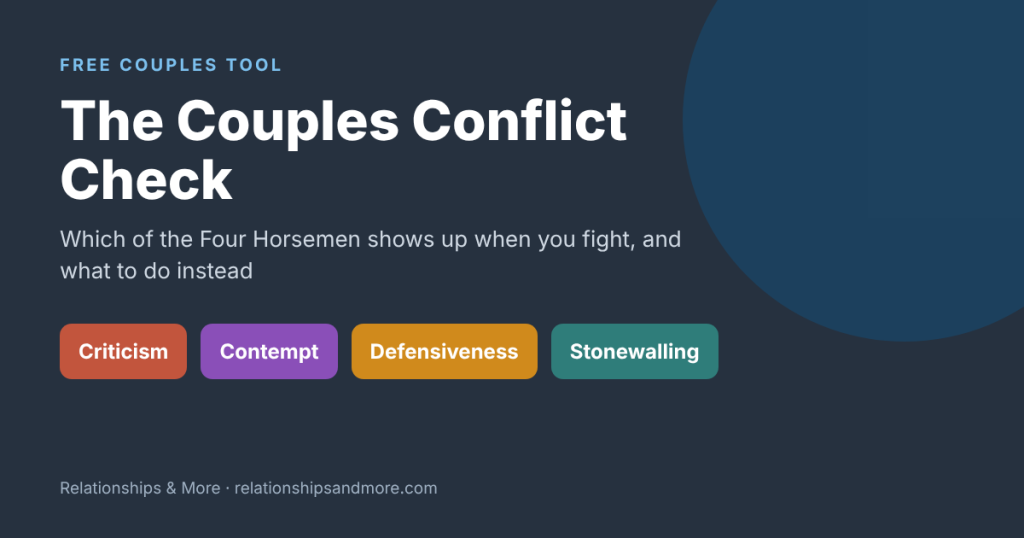
That research gave us one of the most useful ideas in couples therapy: the Four Horsemen. Below you’ll find a free, private tool to check which of these patterns shows up in your relationship, followed by a plain-English guide to what each one means and what to do instead.
Take the Couples Conflict Check
Answer 20 quick questions about how disagreements usually go for you. It takes about five minutes. You can take it on your own, or each partner can answer privately and then compare results side by side. Nothing you enter is saved or sent anywhere.
What are the Four Horsemen of a relationship?
The term comes from psychologist Dr. John Gottman, whose research team spent decades observing couples in conflict. The Gottman Institute describes the Four Horsemen as communication styles that, according to that research, can predict the end of a relationship. They are criticism, contempt, defensiveness and stonewalling.
Every couple slips into these sometimes. Having them show up doesn’t mean your relationship is doomed. What matters is how often they appear, whether they’ve become your default, and how quickly you can repair afterward.
1. Criticism
A complaint is about a specific behavior: “I was worried when you didn’t call to say you’d be late.” Criticism turns that into a verdict on your partner’s character: “You never think about anyone but yourself.” The words “always” and “never” are usually a sign you’ve crossed from one into the other.
The antidote: gentle start-up. Talk about your own feelings and needs, not your partner’s flaws. A simple formula: “I feel ___ about ___, and I need ___.” For example: “I feel anxious when plans change last minute. Can you text me when you’re running late?” Raise one issue at a time, and raise it before resentment builds.
2. Contempt
Contempt is criticism delivered from a position of superiority: sarcasm, mockery, eye-rolling, sneering, name-calling or hostile humor. It tells your partner, “I’m better than you.” The Gottman Institute calls contempt the single greatest predictor of divorce.
The antidote: build appreciation and respect. Contempt grows out of long-simmering negative thoughts about your partner. The counterweight is a steady habit of noticing and saying what you value about them. Gottman’s research describes a ratio of about five positive interactions for every negative one in stable relationships, so the goal isn’t to stop all complaints but to make sure appreciation clearly outweighs them.
3. Defensiveness
Defensiveness is self-protection: explaining why it wasn’t your fault, answering a complaint with a counter-complaint (“Well, you…”), or acting like the innocent victim. It feels justified in the moment, but it tells your partner their concern doesn’t matter, so the conflict escalates.
The antidote: take responsibility, even for a small part. You don’t have to accept all the blame. Find the piece that’s fair and own it first: “You’re right, I didn’t call. I can see why that worried you.” That one sentence often lowers the temperature of the whole conversation.
4. Stonewalling
Stonewalling is withdrawing from the interaction: going silent, looking away, giving one-word answers, or leaving the room. It usually isn’t indifference. It’s what happens when your body is flooded: heart racing, thoughts scattered, and a strong urge to escape.
The antidote: physiological self-soothing. Agree on a way to call a time-out, say when you’ll come back, and use the break to genuinely calm down rather than rehearse your arguments. The Gottman Institute advises that a break should last at least twenty minutes, because that’s roughly how long your body needs to settle. Then come back and finish the conversation.
The cycle most couples get stuck in
The Four Horsemen rarely show up alone. One of the most common patterns we see in couples therapy is a pursue-withdraw cycle: one partner raises issues more and more intensely (often sliding into criticism), while the other shuts down more and more (stonewalling). The pursuer feels ignored; the withdrawer feels attacked. Each person’s coping strategy makes the other’s worse.
If your results show one of you higher on criticism and the other higher on stonewalling, that’s worth naming together. Instead of “you always shut down” or “you’re always on my case,” try: “We get stuck in a loop where I push and you pull away. How can we interrupt it?” Seeing the cycle as the problem, rather than each other, is often the first real step forward.
How to use your results together
- Compare when you’re both calm. Don’t open your results in the middle of an argument. Pick a relaxed moment and agree up front that the goal is curiosity, not scoring points.
- Start with your own pattern. It’s tempting to point at your partner’s highest bar. Talk about your own first, and what makes it hard to change.
- Pick one antidote each. Small, specific changes stick better than big promises. The 7-day practice plan in your results gives you one action per day.
- Plan your repair. Every couple will slip. Agree on a phrase that means “let’s start over,” whether that’s “can we try that again?” or a private joke that breaks the tension.
- Retake it in a month. Patterns shift when you practice. Seeing a lower score is genuinely motivating.
When to talk to a couples therapist
Some couples can turn these patterns around on their own. It’s worth getting support if:
- Contempt shows up regularly, or one of you scores high on it.
- You keep having the same fight and can’t find a way out of it.
- One of you regularly shuts down or leaves, and conversations never get finished.
- You’re recovering from an affair or another breach of trust.
- You’re unsure whether to stay together. Discernment counseling is designed for exactly that question.
Angela Penichet, LCSW, is a Gottman Method–certified couples therapist with over 20 years of experience. She works with couples online anywhere in New York State and in person at her office in Croton-on-Hudson, Westchester. Learn more about couples therapy, or book a free 15-minute consultation.
A note on safety: the Four Horsemen describe everyday conflict between partners who feel safe with each other. If you feel afraid of your partner, or your conflict involves threats, control, intimidation or physical harm, couples tools aren’t the right starting point. Contact the National Domestic Violence Hotline at 1-800-799-7233 (or text START to 88788). In a crisis, call or text 988, or call 911 in an emergency.
Frequently asked questions
What are the Four Horsemen in a relationship?
They are four communication patterns identified in Dr. John Gottman’s research on couples: criticism (attacking your partner’s character), contempt (speaking from superiority, through sarcasm, mockery or eye-rolling), defensiveness (protecting yourself instead of hearing the complaint) and stonewalling (shutting down or withdrawing). Frequent use of them is linked to relationships ending.
Which of the Four Horsemen is the worst?
Contempt. The Gottman Institute describes it as the single greatest predictor of divorce, because it communicates disgust and superiority rather than a solvable problem.
Can a relationship recover from the Four Horsemen?
Yes. These are habits, not personality traits, and each has a well-established antidote. Couples who learn to start conversations gently, express appreciation, take responsibility and take real breaks when flooded can change how their conflicts go, often within weeks of consistent practice. A couples therapist can speed that up.
Is the Couples Conflict Check a diagnosis?
No. It’s a self-reflection tool, not a clinical assessment. It uses original questions informed by published research on couples’ conflict, and it isn’t affiliated with or endorsed by The Gottman Institute. If your results concern you, a licensed couples therapist can give you a fuller picture.
Should we take the quiz together or separately?
Separately, then compare. Each partner should answer privately and honestly about their own behavior. Choose “Both of us,” then either hand the device over or send your partner a link. Their screen will show both sets of results once they finish.